
Co-op Month Comes Early to Massachusetts: Why Worker Ownership Matters
Every October, cooperatives across the country celebrate Co-op Month, an opportunity to shine a light on a business model that millions of people interact with every day, often without realizing it.
This year, here in Massachusetts, we’re getting an early start.
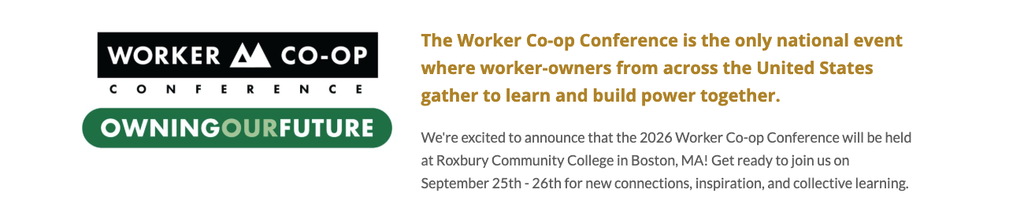
On September 25 and 26, worker-owners from across the United States will gather at Roxbury Community College in Boston for the 2026 Worker Co-op Conference. Organized by the U.S. Federation of Worker Cooperatives and the Democracy at Work Institute, it is the only national gathering specifically dedicated to bringing worker-owners together to learn, connect, build skills, and strengthen the cooperative economy.
As a 100% worker-owned solar cooperative based in Western Massachusetts, we think having that conversation happening right here in our home state is worth celebrating.
It also gives us a good excuse to answer a question we hear pretty regularly:
What does “worker-owned” actually mean?
What is a worker cooperative?
At its simplest, a worker cooperative is a business owned and democratically governed by the people who work there.
Worker-owners participate in the financial success of the business and have representation in its governance. A central principle is straightforward: one worker-owner, one vote.
That is fundamentally different from a traditional business structure in which ownership and decision-making authority are primarily determined by how much capital someone owns.
Worker cooperatives can take many forms and exist in many industries, from food and agriculture to manufacturing, home care, technology, construction, professional services, and, yes, solar.
According to the U.S. Federation of Worker Cooperatives, there are an estimated 1,300 worker cooperatives in the United States employing roughly 15,000 people.
It is still a relatively small piece of the American economy, but it is part of a much larger cooperative tradition that includes food co-ops, credit unions, agricultural cooperatives, housing cooperatives, electric cooperatives, and many other businesses owned by the people who work for or use them.
What does worker ownership look like at PV Squared?
At PV Squared, being worker-owned isn’t a tagline.
It shapes how our company works.
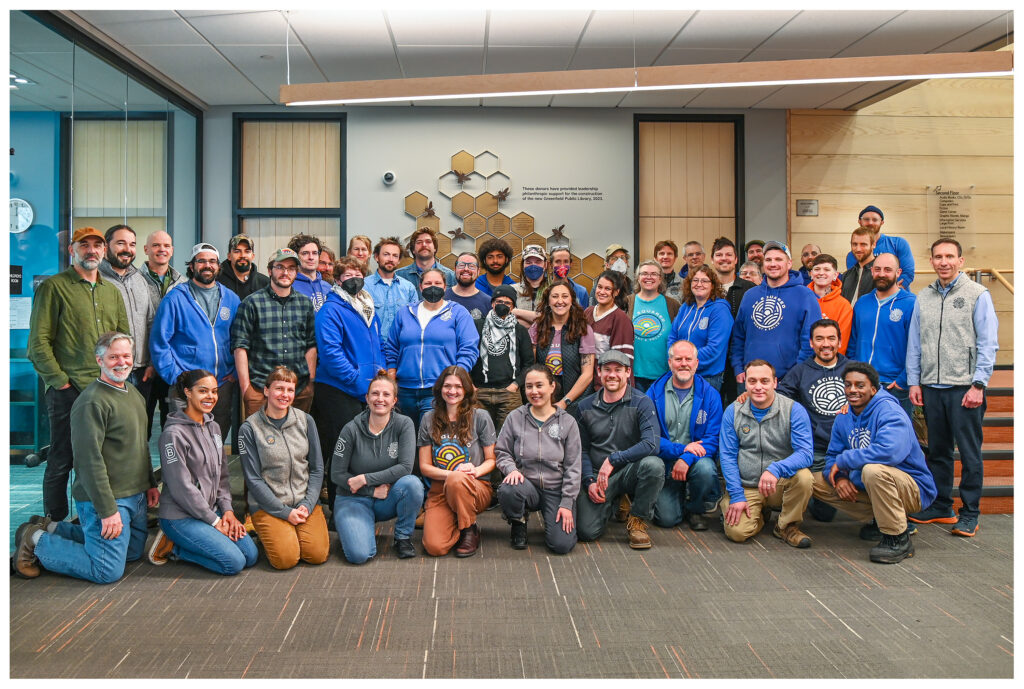
Our worker-owners elect our Board of Directors. We participate in decisions about the direction of the cooperative. We share responsibility for its financial health and long-term future. And the people designing systems, installing solar panels, supporting clients, managing projects, answering phones, servicing existing systems, and doing the many other jobs that keep our company moving have a pathway to become owners of the business themselves.
That doesn’t mean every decision gets made by the entire cooperative or that everyone agrees all the time.
Democratic ownership still requires leadership, management, expertise, accountability, and plenty of difficult conversations.
What changes is who ultimately owns the business and whose interests help shape its future.
For us, that matters.
Why do cooperatives matter to local economies?
One of the things we love most about the cooperative model is that it asks businesses to think beyond the next transaction.
Cooperatives are built around member benefit and democratic participation. The internationally recognized cooperative principles also include cooperation among cooperatives and concern for community.
Those ideas can have very practical consequences.
When ownership is rooted among people who work in a community, decisions about the future of a business are being made by people who have a direct stake in what happens there.
We live nearby.
We raise families there.
We buy groceries, hire contractors, volunteer, serve on boards, coach teams, eat at local restaurants, and participate in the civic life around us.
That doesn’t make cooperative businesses immune to difficult economic realities. We face many of the same pressures as any other business: changing markets, rising costs, competition, workforce challenges, and the need to remain financially sustainable.
But it does mean those realities are being navigated within a structure where workers have an ownership stake in what happens next.
The U.S. Federation of Worker Cooperatives describes worker cooperatives as businesses capable of anchoring capital and jobs in communities while creating opportunities for workers to build assets and participate directly in business decision-making.
That connection between ownership, work, and place is a big part of why cooperatives can be an important tool for local economic resilience.
Cooperation is bigger than any one cooperative
One of the seven internationally recognized cooperative principles is something we particularly love:
Cooperation among cooperatives.
The idea is simple. Cooperatives become stronger when they support, learn from, and build relationships with other cooperatives.
PV Squared is one small part of a much larger ecosystem.
Across the country, people are experimenting with ways to share ownership more broadly, build democratic workplaces, preserve locally rooted businesses, and create companies designed to serve their members for the long haul.
That is part of what makes this year’s Worker Co-op Conference coming to Massachusetts so exciting.
The conference will bring together worker-owners, cooperative developers, policymakers, funders, labor organizers, and others for workshops, skill-building, advocacy, networking, and tours of Boston’s worker-cooperative and solidarity-economy ecosystem.
Its 2026 theme, “Owning Our Future,” feels particularly fitting.
Because cooperative ownership ultimately asks a pretty interesting question:
What changes when the people doing the work also have a meaningful say in the future of the business?
Built for the long view
At PV Squared, we spend a lot of time talking about the long view.
Solar is infrastructure designed to produce energy for decades. The decisions made during design and installation matter years after the trucks leave the driveway.
We think about our business similarly.
Being worker-owned asks us to consider not only what makes sense today, but what kind of company we are building for the people who will work here tomorrow.
How do we create meaningful local jobs?
How do we preserve institutional knowledge?
How do we build a company capable of supporting solar systems throughout their operating lives?
How do we make decisions that strengthen both the cooperative and the communities that sustain it?
We don’t pretend cooperative ownership automatically provides easy answers to those questions.
But it gives us a structure for asking them together.
And after more than two decades as a worker-owned solar cooperative in Western Massachusetts, we still believe that’s something worth investing in.
Celebrating Co-op Month, a little early
October is National Co-op Month, but with worker-owners from around the country gathering in Boston this September, we’re happy to start celebrating a little early.
Throughout Co-op Month, we’ll be sharing more about what worker ownership looks like inside PV Squared, and highlighting the broader cooperative economy we’re proud to be part of.
Because solar isn’t the only thing we’re interested in building for the long term.
We’re also interested in strong local businesses, meaningful jobs, resilient communities, and an economy where more people have the opportunity to participate in the ownership of the places where they work.
That’s the cooperative idea.
And we’re pretty proud to be part of it.